Businesses are now expected to optimize bids, keywords, creatives, and budgets in real time—often across
hundreds or thousands of campaigns. AI-powered advertising tools are transforming how businesses manage Google Ads by automating optimization,
reducing wasted spend, and enabling data-driven decision-making at scale. At
campaign-ai.com,
we focus on using artificial intelligence to turn Google Ads into a predictable and performance-driven
growth channel.
The Challenges of Traditional Google Ads Management
Before AI adoption, Google Ads management relied heavily on manual processes such as periodic bid adjustments,
static keyword lists, and reactive optimizations. These approaches struggle to keep up with modern advertising
demands.
- Data overload: Too many performance signals for humans to analyze continuously
- Delayed optimization: Changes are often made after budgets are already wasted
- Scaling limitations: Manual processes fail as campaigns grow
How AI Tools Improve Google Ads Performance
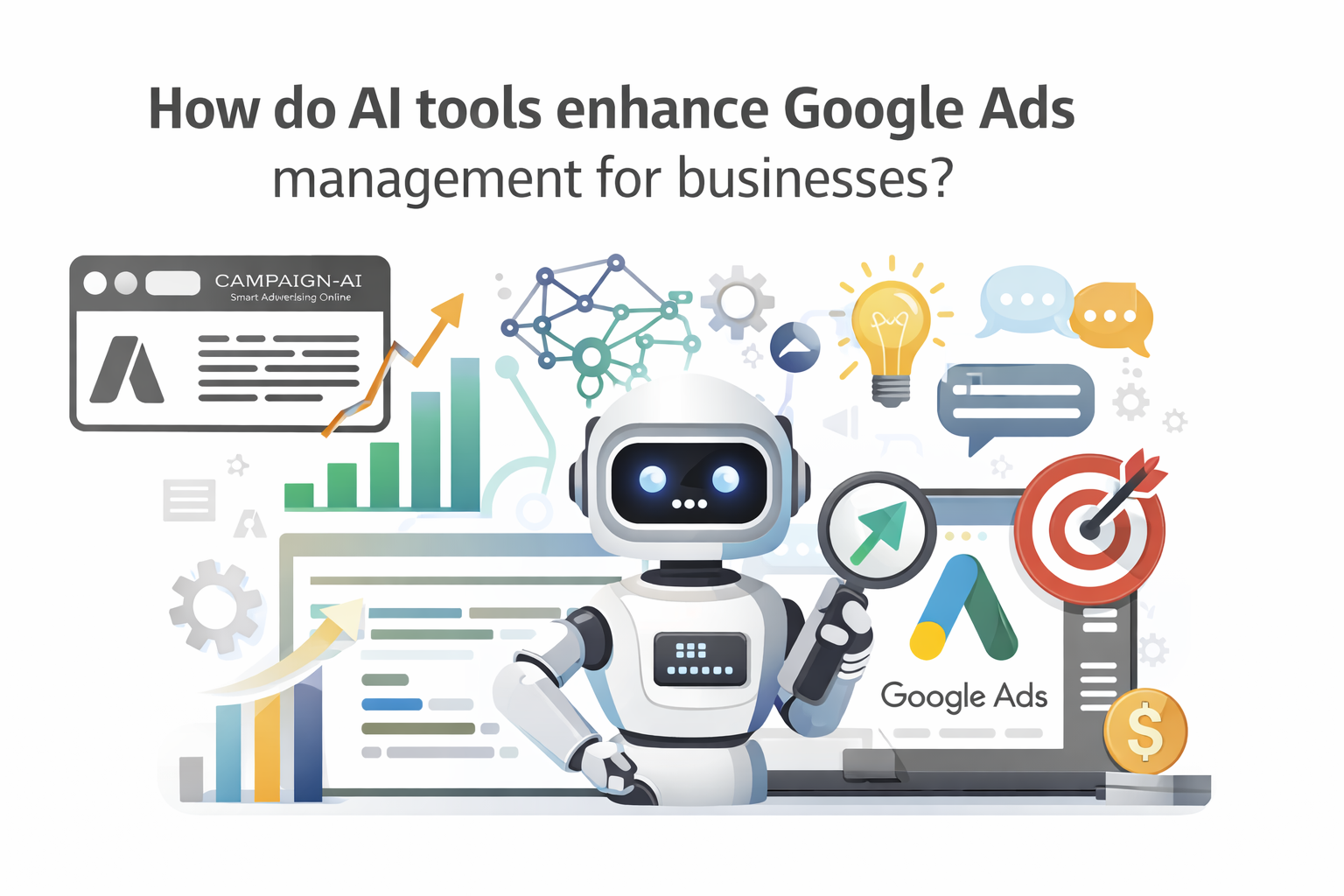
AI enhances Google Ads management by operating across four key areas: automation, intelligence, prediction,
and personalization. These capabilities allow businesses to optimize campaigns in real time with greater
accuracy and consistency.
1. Automated Bid Optimization
AI tools analyze conversion probability, device type, location, time of day, and user behavior to adjust bids
dynamically. Instead of relying on fixed bids, AI continuously optimizes bids in real time to maximize results.
- Lower cost per acquisition (CPA)
- Higher return on ad spend (ROAS)
- Reduced overspending on low-intent traffic
2. Smarter Keyword and Search Term Analysis
AI-driven systems evaluate search intent rather than just keyword matching. This allows advertisers to identify
high-converting queries, eliminate irrelevant traffic, and automatically expand into profitable long-tail keywords.
The result is higher-quality traffic and improved conversion efficiency.
3. Predictive Performance Modeling
AI tools use historical and real-time data to forecast campaign performance. They can detect early signs of
declining results, audience saturation, or rising costs before these issues impact profitability. This predictive capability enables proactive optimization instead of reactive adjustments.
4. AI-Driven Ad Creative Optimization
AI tools test multiple ad variations simultaneously and identify messaging patterns that resonate with specific
audience segments. Over time, the system learns which headlines, descriptions, and calls to action perform best. This leads to improved click-through rates and higher conversion rates without manual testing overhead.
5. Fraud Detection and Traffic Quality Control
Invalid clicks, bots, and low-quality traffic can drain advertising budgets. AI systems monitor behavior patterns
such as abnormal click frequency and repeated non-converting sessions to identify fraudulent activity. By blocking invalid traffic, AI protects ad budgets and improves the accuracy of campaign data.
6. Intelligent Budget Allocation
AI tools automatically rebalance budgets across campaigns based on performance. Spend is shifted toward
high-performing campaigns while underperforming segments are reduced or paused. This ensures that budgets are used as efficiently as possible.
How AI Changes the Role of Marketers
AI does not replace marketers—it enhances their effectiveness. By automating repetitive optimization tasks,
AI allows marketers to focus on strategy, creative direction, funnel optimization, and business growth. AI becomes a decision-support system that improves speed, accuracy, and scalability.
Why Businesses Are Adopting AI for Google Ads
Businesses adopt AI-driven Google Ads tools because they deliver faster optimization cycles, consistent
performance improvements, and scalable campaign management. For small teams and growing companies,
AI levels the playing field against larger competitors.
How Campaign-AI Helps Businesses Succeed
At
campaign-ai.com, our AI-driven approach focuses on intelligent automation, transparent insights,
and optimization aligned with real business goals—not vanity metrics. By combining machine intelligence with strategic oversight, businesses can run Google Ads campaigns that
are smarter, more efficient, and more profitable.
Conclusion
AI tools enhance Google Ads management by automating bidding, refining targeting, optimizing creatives,
predicting performance, and protecting ad budgets. In a competitive digital advertising landscape,
AI is no longer optional—it is a competitive advantage.